
When engineering a deeply resilient DIY lithium (LiFePO4) solar array or an off-grid UPS backup in Pakistan, the physical battery cells are only half the equation. The digital brain managing those cells—the Battery Management System (BMS)—is what determines whether your investment lasts for ten years or catches fire in ten months.
For high-capacity lithium banks dealing with extreme Pakistani summer heat and unpredictable load-shedding cycles, the JK Smart BMS series has emerged as the undisputed industry standard. However, selecting between their B1A (1 Amp Active Balancing) and B2A (2 Amp Active Balancing) architectures across varying continuous current limits (100A, 150A, 200A) requires exact mathematical precision.
In this technical deep-dive, we will decode the exact specifications of the B1A and B2A lineups so you can pair the absolute correct hardware with your off-grid system.
1. The Technical Matrix: B1A vs B2A Series Breakdown
To establish a baseline, we must analyze the hardware limits of JK’s most popular 8-string (24V) to 24-string (72V) units. This table serves as your primary reference sheet.
| Model Series | Cell Config | Continuous Current | Active Balancing | Comms Interface | Optimal Setup |
|---|---|---|---|---|---|
| B1A8S10P | 4S – 8S (12V-24V) | 100A (Peak 200A) | 1A | BT / RS485 | Basic 12V UPS (Up to 1.2kW) |
| B1A8S20P | 4S – 8S (12V-24V) | 200A (Peak 350A) | 1A | BT / RS485 | Heavy 12V/24V Inverters (2.4kVA+) |
| B2A8S20P | 4S – 8S (12V-24V) | 200A (Peak 350A) | 2A | BT / RS485 / CAN | High-Cycle 24V Systems & Evs |
| B1A24S15P | 8S – 24S (24V-72V) | 150A (Peak 300A) | 1A | BT / RS485 | Standard 48V (7.2kW Limit) |
| B2A24S20P | 8S – 24S (24V-72V) | 200A (Peak 350A) | 2A | BT / RS485 / CAN | Premium 48V Home Solar Arrays |
2. Deep Dive: Decoding Active Balancing (1A vs 2A)
The defining feature of the JK BMS ecosystem is its Active Balancing. Unlike passive balancers that simply burn off excess voltage from high cells as wasted heat (usually at a weak 0.05A to 0.1A rate), Active Balancers magically transfer energy from the highest voltage cell entirely down into the lowest voltage cell.
When is 1A (B1A Series) Sufficient?
The 1A active balancing circuit can shift 1 Amp of current between cells. If you are building a relatively small pack using pristine, matched Grade A 100Ah lithium cells, the voltage drift over time will be negligible. A 1A balancer can easily maintain harmony in this system.
Why Pakistani Heavy-Users Demand 2A (B2A Series)
If you are building a massive 314Ah or 280Ah battery bank to fight prolonged Pakistani power outages, a 1A balancer will struggle to keep up mathematically. If a 314Ah cell drifts by just 5%, that is 15.7 Amp-hours of deviation! A 1A balancer would take 15.7 hours to correct that single cell.
A B2A unit utilizing 2A Active Balancing cuts synchronization time in half, ensuring your heavy EV or massive domestic solar array remains perfectly balanced even under intense 100A+ discharge loads during the summer.
3. Amperage Metrics: Continuous vs Peak Rating
Your BMS Continuous Current rating is a hard cap. It must exceed the maximum draw of your solar inverter. In Pakistan, we frequently run heavy 1.5-ton Inverter Air Conditioners off batteries.
BMS Selection Logic
100A BMS Unit
150A BMS Unit
200A BMS Unit
Example Math: If you are running a 5kW (5000 Watt) inverter on a 48V system.
5000W / 48V = 104 Amps Continuous.
Because you never want to run hardware at 100% capacity continuously in a hot climate (35°C+ ambient temperatures), an engineer would reject a 100A BMS and select the 150A Continuous or 200A Continuous model to ensure the internal MOSFETs remain cool, preventing thermal throttling.
4. Communication Architecture (RS485 & CAN)
Smart inverters (like Voltronic, Growatt, and Deye setups popular in PK) rely on Closed-Loop communication.
Closed-Loop CAN/RS485 Protocol Flow
- Step 1: BMS sends real-time State of Charge (SOC %) downstream.
- Step 2: BMS dictates hard Limits: “Stop charging at 56V / 100A.”
- Step 3: Inverter dynamically obeys, throttling solar yield instantly.
Both B1A and B2A series sport Bluetooth for local smartphone monitoring, but high-end B2A units often come standard with native CANbus and multi-port RS485 for seamless integration into modern solar firmware ecosystems.
5. Decision Matrix: Which JK Model is Right For You?
Here is the OffGridStore engineering consensus for the Pakistani market:
- Budget 12V UPS Backup (Small Fans & Lights): Use the JK B1A8S10P. It handles 1.2kW perfectly.
- Standard 5kW Solar Setup (48V / 16S): The JK B1A24S15P sits exactly in the sweet spot of affordability and headroom.
- Premium Heavy-Load Array (Running ACs / 314Ah Cells): The JK B2A24S20P is non-negotiable. Its 2A balancer handles massive capacities, and its 200A throughput guarantees cold MOSFETs under heavy inverter loads.
Recommended Hardware:
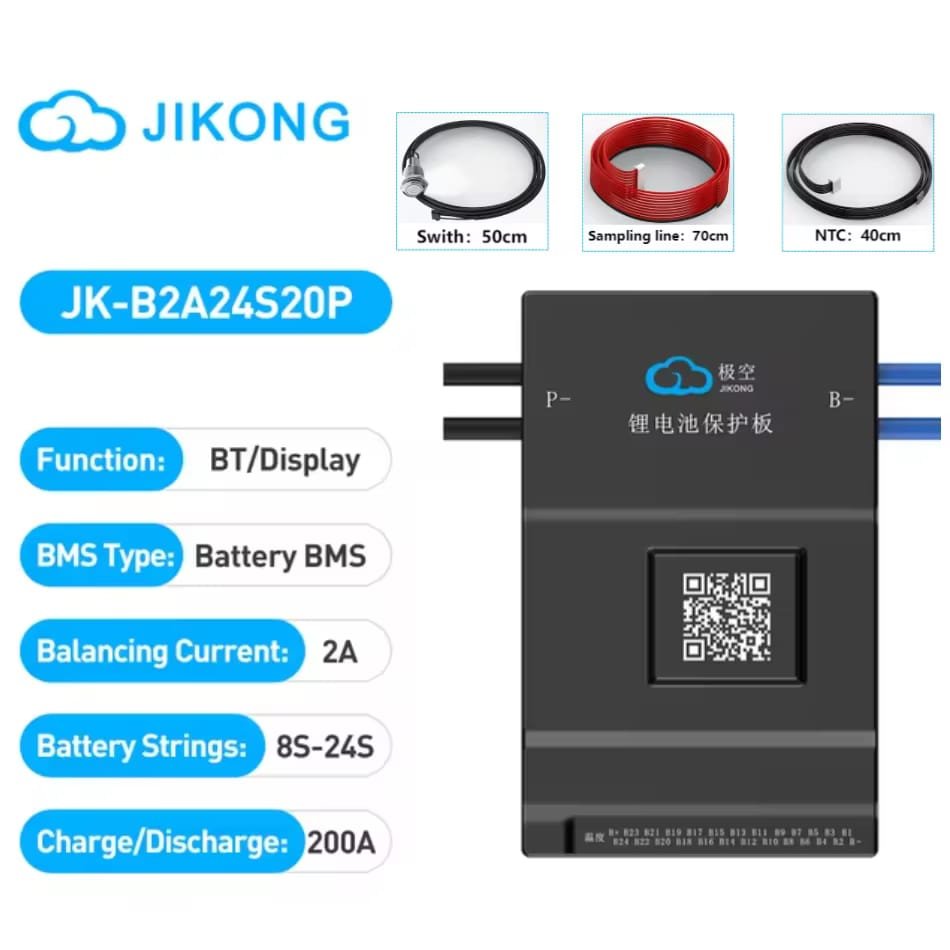
JK Smart BMS 8S-24S 200A with 2A Active Balancing – JK-B2A24S20P
Heavy-duty capability optimized explicitly for rigorous loadshedding resistance.
Frequently Asked Technical Questions (FAQ)
Q: What is the self-consumption current of these JK BMS units?
A: JK units are incredibly efficient, consuming roughly 20mA in standby and <3mA in deep sleep (undervoltage protection). This prevents phantom drain on your battery bank.
Q: Can I use the B2A24S20P on a 48V (16S) system even though it says 24S?
A: Yes! The JK UI allows you to software-define your cell count anywhere from its minimum rating (8S) up to its maximum (24S).
Q: Does the BMS protect against Pakistani summer heat?
A: Yes. All models feature dual NTC temperature probes. You can program exact Charge Over-Temperature Protection (typically 55°C) and Discharge Over-Temperature Protection (typically 65°C) limits via the Bluetooth app.
Conclusion
Selecting a BMS is not a place to cut corners. Whether you require the budget-friendly 100A 1A balancer or the absolute flagship 200A 2A CANbus integration, matching the continuous current and active balancing strength to your cell size is the only way to guarantee a 10-year lifespan. Ensure your lithium investment pays off securely.
Need help dialing in your specific inverter or calculating your amp draw? Contact our engineering team right now at 03249094945 for exact hardware matching.